Perpetual Futures vs Spot: How the Price Gap Creates Arbitrage Profit
If spot is the "cash" market and perpetual futures are the leveraged crowd favorite, you should expect them to stay close—but not identical.
That difference is often called basis. Basis is not automatically free money, yet it is the language of spot-futures arbitrage and many futures arbitrage routines.
What Basis Actually Means Day to Day
When perp trades above spot, you might hear "positive basis." Below spot, "negative basis."
Basis changes with:
- leverage demand
- risk appetite
- funding expectations
- liquidity and borrow constraints
Your job is not to moralize the gap. It is to ask whether you can capture it net of fees with a hedge that survives volatility.
The Classic Hedged Story (High Level)
A simplified profitable bias some traders chase when funding and basis align:
- buy spot
- short perp with similar notional
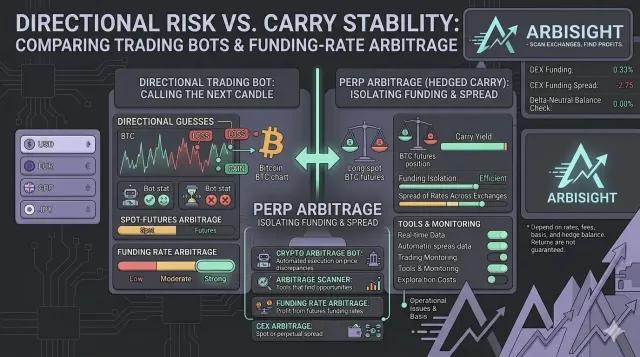
You are not cheering for rockets; you are trying to isolate carry and mean reversion mechanics.
But basis can worsen before it heals—buttressing why Portfolio Management and margin buffers matter.
Why Arbitrage Perpetuals Are a Category of Their Own
Arbitrage perpetuals traders think in two ledgers:
- market exposure (delta)
- carry (funding, fees, borrow)
If delta is not controlled, you are back to directional risk in cosplay.
Tools: From Scanner to Order Book
Discovery often starts with an arbitrage scanner view, but professionals validate with Orderbook Snapshot and Live Crypto Arbitrage context.
Spread tracking across venues also matters when spot prices themselves differ slightly by exchange.
Funding Enters the Equation
Even if basis looks cute, funding can dominate PnL short term.
Pair this article's idea with Funding Cycle Timing Strategy so you are not casually paying carry you did not model.
Execution: Where Pretty Math Dies
Two painful truths:
- fills are not simultaneous in the real world
- partial fills create temporary directionality
That is why Slow Entry and careful sizing beat heroic market orders when liquidity is patchy.
Alerts and Watchlists Keep You Honest
Use Alerts for basis spikes, funding sign flips, or margin ratio creep. Use Watchlist to stop random market hopping.
Is This the Most Profitable Type of Cryptocurrency Arbitrage?
Maybe sometimes—for some traders. There is no crown forever.
The sustainable edge is usually repeatable process plus honest accounting via Arbitrage Profits.
A Beginner Friendly Guardrail
If you are newer, simulate first. Then trade small on the most boring liquid pair you can stand. Exciting charts often hide expensive slippage.
When Basis Expands: Patience vs Intervention
Basis can widen because leverage demand spikes, because index components disagree slightly across venues, or because liquidity pockets shift.
Sometimes the adult move is patience; sometimes it is reducing size so your hedge stays robust. The wrong move is usually martingale-style doubling because you cannot stand marking a temporary dislocation.
Borrow Costs and Spot Leg Reality
Not everyone funds a spot leg with idle coins. If borrowing enters the picture, your crypto spread thesis changes character.
Before calling something most profitable type of cryptocurrency arbitrage, bake in carry costs you cannot hand-wave away.
Venue Pairing Without Superstition
Traders love arguing brand names, but pairing is logistics: which two books can you trust at your size, with stable APIs, and tolerable withdrawal paths if you need them.
That practical framing keeps expectations closer to Earth.
Using AI Assistance Without Outsourcing Judgment
AI assistant crypto workflows can summarize exchange rules or help you build checklists. They cannot replace live Alerts and your margin ratio.
Use assistance for drafts and research; keep accountability for clicks.
When Basis Trades Become Emotional
The hardest part of basis is not the chart; it is the moment your hedge looks wrong and social media screams a directional story.
If you are running spot-futures arbitrage, write your rules when calm. Calm rules beat panic narratives.
Learning Milestones That Actually Matter
Milestone one: you stopped trusting screenshots. Milestone two: you started measuring slippage honestly. Milestone three: you treat Portfolio Management as part of the strategy, not an optional app.
Everything else is commentary.
Basis Moves and the "Just Wait" Trap
Waiting is sometimes correct; denial is not. If basis moves against you for reasons you did not anticipate, update the thesis instead of defaulting to hope.
The strongest spot futures arbitrage bot fantasy is effortless mean reversion. Reality usually charges patience and a margin story.
One Habit That Improves Net Results
After each close, write one line: "what would I do differently on execution?" Execution journals improve net results faster than new indicators.
If you want one more guardrail, decide in advance how much basis widening you will tolerate before reducing size. A predefined threshold prevents panic bargaining with the market.
Disclaimer: This article is for educational purposes only and is not financial advice. Always do your own due diligence before trading.