Why Most Crypto Trading Bots Stay Risky — and Why Funding-Rate Perp Arbitrage Often Isn’t
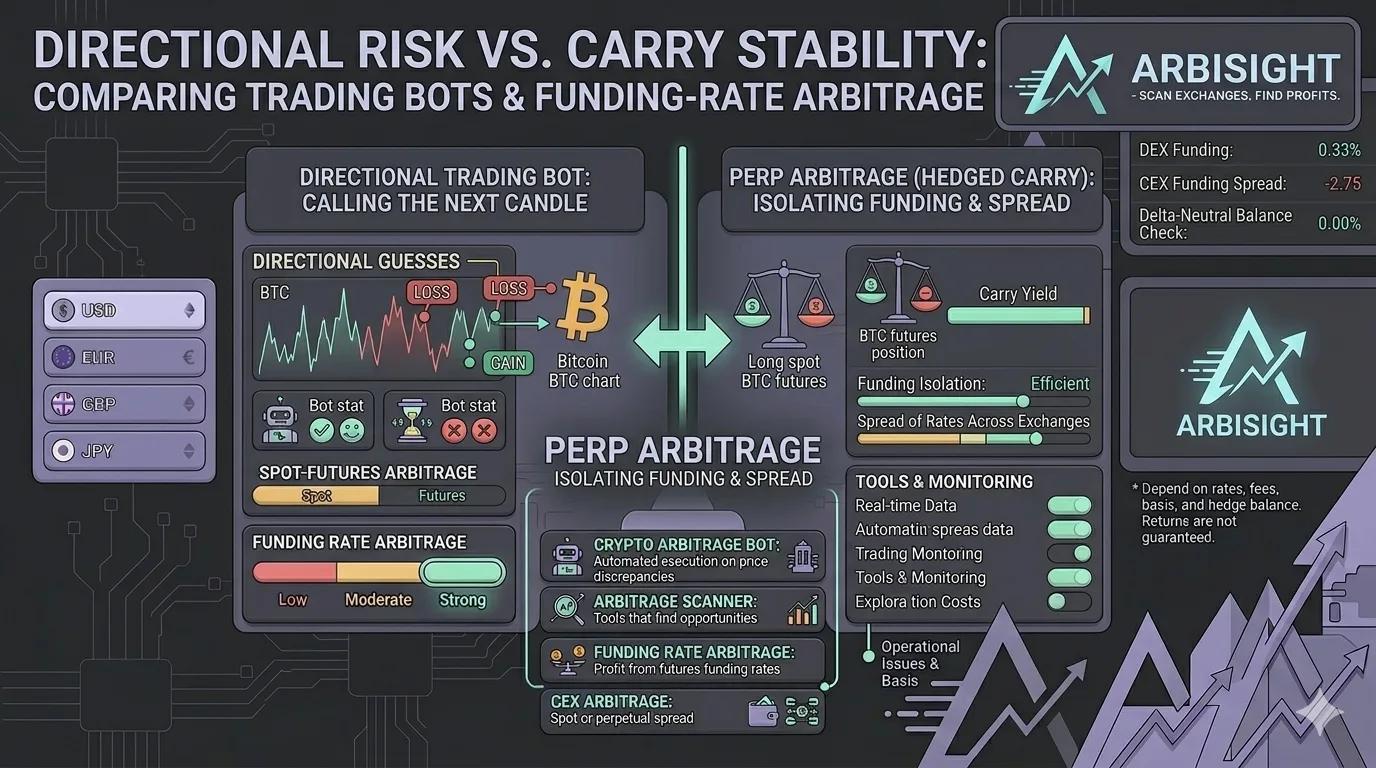
If you are comparing a crypto trading bot to funding rate arbitrage on arbitrage perpetuals, you are not comparing two versions of the same product. One is usually built to trade direction (or tight mechanical rules that still depend on price path). The other, done properly, is closer to carry: you try to isolate funding and spread of rates across exchanges, not call the next candle.
Neither is “safe” in any absolute sense. Markets can hurt any strategy. But the dominant risk modes are different — and that matters when you decide how much capital and attention a setup deserves.
Why automated trading bots still carry serious risk
People associate bots with precision. In practice, bots amplify whatever assumptions you baked in — including the bad ones.
Direction and regime risk
Most retail-facing bots ultimately depend on price going your way over some horizon, or on stats that held in backtests until they did not. When volatility regimes flip, correlations break, and liquidity thins, the same bot logic can produce losses faster than a human would tolerate manually.
Execution and infrastructure risk
Even a good signal is worthless if orders fail, APIs lag, exchanges rate-limit, or your VPS goes down during a gap. Crypto markets do not pause because your bot crashed.
Overfitting and false confidence
Backtests are seductive. A curve-fit strategy can look brilliant until slippage, fees, and funding are applied with realistic assumptions — then edge shrinks or disappears.
Counterparty and “bot product” risk
Third-party bots add another layer: opaque logic, withdrawal friction, and in the worst cases outright fraud. If you cannot explain what the bot does under stress, you do not control the risk.
Leverage magnifies everything
Many bot setups run with leverage to make small edges look exciting. Leverage turns ordinary variance into account-threatening moves.
So when someone asks how does arbitrage bot work at a high level, the honest answer for directional automation is: it works until the market changes faster than the rules do. That is why serious operators talk about risk limits, kill switches, and monitoring — not “set and forget.”
Funding-rate futures arbitrage: what is actually different
Funding rate arbitrage on perpetuals (and related hedged structures) is not magic. You still have fees, basis, and operational risk. But the economic idea is different from buying breakouts or grid-trading a trend.
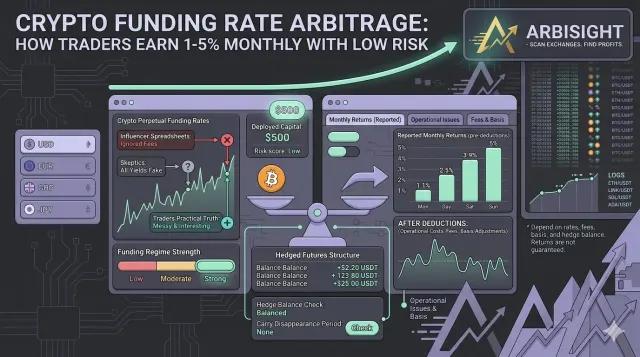
In a typical funding-focused setup, you aim to be roughly delta-neutral (or close): for example, exposure on one exchange is offset by an opposite position elsewhere, or against spot, so your P/L driver is more about who pays funding and how rates differ across venues, not about predicting whether Bitcoin finishes the week green or red.
That matters because market direction is one of the hardest problems in trading. A hedged carry workflow does not remove risk — but it changes which risks dominate:
- Funding can flip sign (carry disappears or reverses).
- Basis between spot and perp (or between venues) can move against you.
- Liquidation and margin still exist if hedges slip or margin is too tight.
- Operational risk (withdrawals, APIs, exchange policy) remains real.
When those are managed with conservative sizing and monitoring, many traders find the distribution of outcomes more like a slow yield problem with known failure modes than a directional bet that requires constant prediction accuracy. That is why earn from funding rate conversations often emphasize process, fees, and buffers instead of win-rate bragging.
Why “lower risk / higher chance of gains” must be qualified
It is fair to say funding-focused perp arbitrage can offer a more structured edge than discretionary scalping for traders who execute well — not that it guarantees profit.
Gains depend on persistent funding differentials, capital deployed, fee tiers, and holding through volatility without breaking the hedge. Risk is lower mainly in the sense of reduced naked directional exposure, not zero risk.
If you want a disciplined workflow instead of pure automation hype, combine:
- Live Crypto Arbitrage — surface opportunities with a free crypto arbitrage scanner mindset (free to start on ArbiSight’s core scans)
- Arbitrage Profits — sanity-check expected return versus fees
- Alerts — free funding rate alerts style notifications when your assumptions stop matching reality
- Portfolio Management — keep hedges aligned as balances and rates move
- Orderbook Snapshot — judge whether your size is realistic before you commit
For real captured funding windows (not theory), our data-driven posts include examples such as CHIPUSDT funding case study and ENJUSDT funding case study.
Bottom line
Automated trading bots often fail for predictable reasons: direction, fragile assumptions, execution, and leverage. Funding-rate arbitrage on futures / perpetuals can still lose money — but the edge, when present, usually comes from carry mechanics and cross-exchange inefficiency, not from calling the next move.
Choose tools that match the job: if you want discovery and monitoring without pretending risk disappears, a stack built around arbitrage scanner workflows and funding rate tracking tends to age better than an opaque bot promising effortless returns.
Disclaimer: Educational content only; not financial advice. Trading and arbitrage involve risk of loss, including loss of principal.