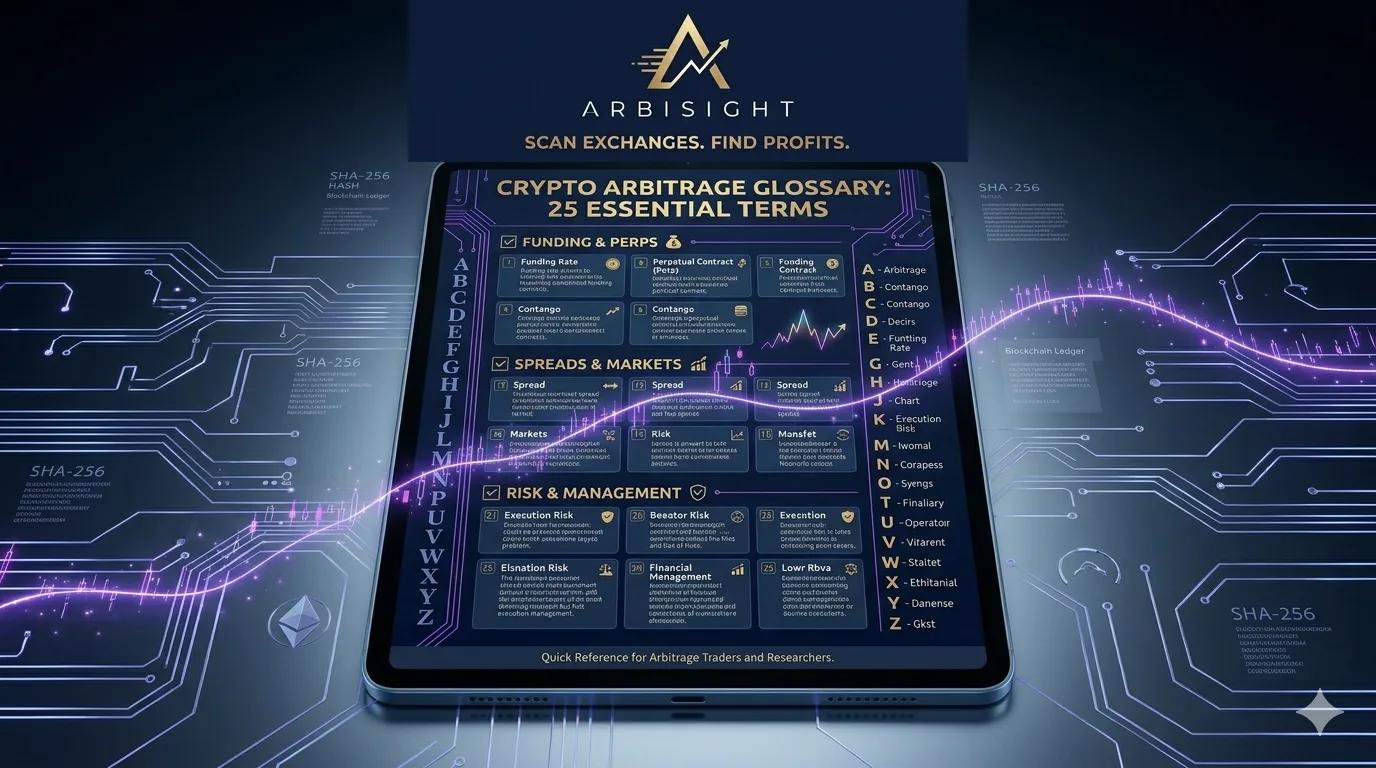
Crypto Arbitrage Glossary: 25 Terms Every Arbitrage Trader Must Know
If you are tired of half-explained Twitter threads, this crypto arbitrage glossary is a single reference for crypto arbitrage terms you will see in scanners, funding dashboards, and exchange docs. Definitions are practical — tuned for funding rate arbitrage, arbitrage perpetuals, and cross-exchange workflows — not academic perfection.
When you are ready to move from vocabulary to execution, Live Crypto Arbitrage is the natural next stop for discovery; Arbitrage Profits helps translate headlines into net outcomes after fees.
Core market concepts
1. Arbitrage
Buying and selling (or hedging) related instruments to capture a price difference or carry edge while limiting unwanted exposure — when execution costs allow.
2. Spread
The gap between two prices or implied yields — for example bid vs ask, or perp vs spot. Spread tracking is how crypto arbitrage earnings become real or evaporate.
3. Basis
The difference between perpetual price and spot (or between two venues). Basis can create opportunity — and stress — for hedged books.
4. Slippage
The gap between expected fill price and actual average fill. Large slippage kills funding rate arbitrage that looked great at mid prices.
5. Liquidity
How much size can trade without moving price badly. Liquidity is why Orderbook Snapshot matters before sizing.
6. Order book depth
Cumulative bids and asks by price level — used to estimate feasible size and slippage.
Perpetuals & funding
7. Perpetual (perp)
A futures-like contract with no fixed expiry; price is tethered toward spot via funding.
8. Funding rate
Periodic transfers between longs and shorts so perps stay near index price. The core variable in many funding rate arbitrage strategies.
9. Funding interval
How often funding settles (e.g. hourly, every few hours). Funding rate tracking requires knowing both rate and schedule.
10. Annualized funding / APY-style framing
A way to compare short funding prints across horizons — useful, easy to abuse if you pretend every hot week repeats for a year.
11. Carry
Income-like return from holding a position benefit — here often net funding after costs — rather than betting on direction.
12. Cross-exchange arbitrage
Exploiting differences between exchanges — prices, funding, or borrow costs — usually with transfers or mirrored hedges.
Positions & risk metrics
13. Long / short
Owning upside exposure vs downside exposure. In hedged books you often hold long and short instruments simultaneously.
14. Delta
Sensitivity of portfolio value to underlying spot moves. Delta-neutral strategies aim near-zero net delta.
15. Delta-neutral
Balancing exposures so you are not primarily betting on price direction — common in hedged futures / perp funding workflows.
16. Notional
Face value scale of a position used for sizing discussions — distinct from margin posted.
17. Margin
Collateral supporting leveraged positions. Thin margin increases liquidation risk even if you feel “hedged.”
18. Liquidation
Forced closure when margin cannot support the position. A core hazard if hedges slip or basis moves sharply.
19. Hedge
An offsetting position meant to reduce unwanted risk — execution quality determines whether it works.
Fees, execution & operations
20. Maker / taker fee
Exchange fees for resting orders (maker) vs taking liquidity (taker). Fee tiers dominate realized crypto arbitrage between exchanges outcomes.
21. Withdrawal friction
Time and cost to move assets between venues — often the hidden tax on cross-exchange ideas.
22. API rate limit
Exchange throttling on programmatic requests — operational risk if your tooling stalls mid-trade.
23. Hedge drift
When long and short notionals diverge after fills, funding, or transfers — silent directional leakage.
24. Risk-adjusted return
Return scaled by volatility or worst-case stress — headline APY is not risk-adjusted by itself.
25. Opportunity quality
Whether an edge survives fees, slippage, and operational constraints — what Arbitrage Profits is meant to sanity-check versus hype.
Putting the glossary to work
Knowing crypto arbitrage terms is not edge — it is vocabulary for safer execution. Pair this reference with:
- Live Crypto Arbitrage — scan like a free crypto arbitrage scanner (free to start on core discovery)
- Alerts — free funding rate alerts where your plan allows
- Portfolio Management — reduce hedge drift
For deeper strategy context, read Funding Rate Arbitrage vs Staking (2026) or the 2026 funding playbook.
Disclaimer: Educational content only; not financial advice. Definitions simplify exchange-specific rules; always read contract specs on each platform.