What Is Funding Rate in Crypto Perpetual Futures? Explained Simply
Perpetual futures never settle like dated futures. So exchanges need a mechanism to keep perp prices tethered to spot. That mechanism is funding—periodic cash flows between longs and shorts.
If you are new to arbitrage perpetuals, funding is also where many crypto arbitrage earnings come from in market-neutral trades.
The One-Sentence Version
Funding is a scheduled payment between traders that nudges the perpetual's price toward the index (spot).
- When funding is positive, longs typically pay shorts.
- When funding is negative, shorts typically pay longs.
Exchanges publish a funding rate (often hourly or every eight hours depending on venue rules). Your job as a trader is to know the sign, size, and stability—not memorize every formula variant across venues.
Why Funding Exists (Without the Drama)
If perps traded like a carnival guess, they could drift far from spot forever. Funding makes carrying a crowded position costly, which keeps the system less silly in equilibrium.
Think of it like a pressure valve:
- too much leveraged long interest can raise perp above spot
- positive funding charges longs
- that discourages infinite one-way leverage
Who Pays Whom in Plain Practice
If you are long perp, positive funding usually reduces your edge unless price movement compensates.
If you are short perp, positive funding can contribute positively—this is the classic carry intuition people chase with funding rate arbitrage.
But funding is not "income" until you subtract fees, slippage, and basis uncertainty. That is where crypto arbitrage tools earn their keep.
How Traders Use Funding (Beyond Directional Bets)
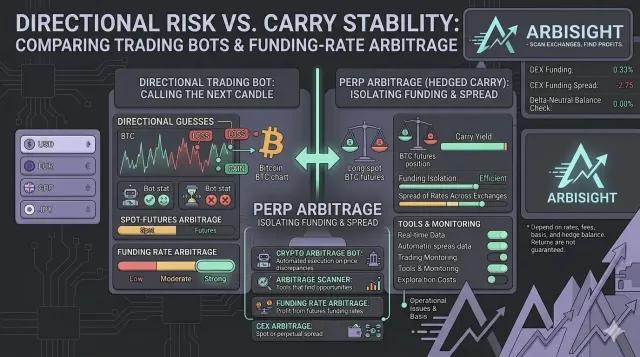
Many experienced traders pair spot and perp to stay roughly delta-neutral, aiming to earn from funding rate while hedging directional risk.
This is why you will hear "short perp, long spot" so often in bullish funding regimes.
Use Funding Cycle Timing Strategy to avoid clumsy entries right before a funding print, and Live Crypto Arbitrage to see how crowded a coin cohort is across venues.
Funding vs Fees: Do Not Confuse the Ledger
Traders sometimes mix:
- taker/maker trading fees (execution)
- funding (carry)
Both hit your account, but they are not the same line item. When modeling an edge with Arbitrage Profits, include all-in assumptions or your plan will look shinier than reality.
Reading Extremes: Opportunity or Trap?
Big funding can mean strong sentiment—or a squeeze setup. Before chasing it, look at spread tracking and book depth with Orderbook Snapshot.
A free crypto arbitrage scanner can highlight contrasts quickly, but it will not replace judgment on whether you can exit safely.
Beginners: Start With Observation
If you want crypto arbitrage for beginners, spend a week tracking funding prints without trading:
- note sign changes
- note volatility events
- note which pairs revert vs stay stretched
Then add Alerts and a small watch routine via Watchlist before sizing up.
Keep It Operational
Funding is simple on paper and messy live—especially across multiple venues. Portfolio Management helps you avoid duplicated risk and nasty margin surprises.
Intervals: Why "Every Eight Hours" Changes Your Routine
Some venues print funding more frequently than others. That does not automatically mean more income—it means more touchpoints where your assumptions can break.
If you are learning, pick a cadence you can observe without ruining your schedule. Once you understand the rhythm, automation and Alerts become force multipliers instead of crutches.
Premium, Discount, and the Language Traders Actually Speak
When perp trades above spot, traders may say the market is "trading rich." Below spot can be called "cheap" relative to index.
Funding is one mechanism that encourages the crowd not to stay rich or cheap forever. That is also why spot-futures arbitrage conversations often tie basis and funding together rather than treating them like strangers.
A Practical Example Without Promising Returns
Imagine a positive funding regime where longs pay shorts. A hedger might hold spot and short perp to reduce directional exposure while collecting carry—if fees, basis, and margin requirements cooperate.
The point is structure: funding is the recurring ledger line that might help—or hurt—depending on side, sign, and stability.
Data Hygiene for Funding Readers
Compare apples to apples. If one screen annualizes and another prints per interval, you will miscalculate edge and feel either genius or doomed incorrectly.
This is one reason crypto arbitrage tools matter: they reduce unit mismatches when you use them thoughtfully.
A Week-One Observation Drill
If you are learning funding without trading, track three coins for seven days: sign changes, magnitude, and any relationship to broader market moves.
You will start to see which names mean-revert faster and which ones stay stretched. That qualitative map is more valuable than one lucky fill because it informs Watchlist construction.
What Pros Still Get Wrong
Even experienced traders confuse interval conversions under pressure. Build a personal cheat sheet and keep it boringly consistent.
Speed without standards is how accounts learn expensive lessons.
Disclaimer: This article is for educational purposes only and is not financial advice. Always do your own due diligence before trading.