Crypto Funding Rate Arbitrage Strategy Guide (2026)
If you have spent any time around crypto Twitter, you have probably seen funding rate arbitrage described as "free yield." In practice, it is not free and it is not effortless.
What it can be is a very solid strategy for traders who execute cleanly and manage risk like professionals.
What This Strategy Really Is
Perpetual futures need a funding mechanism to stay close to spot prices.
- Positive funding: longs pay shorts
- Negative funding: shorts pay longs
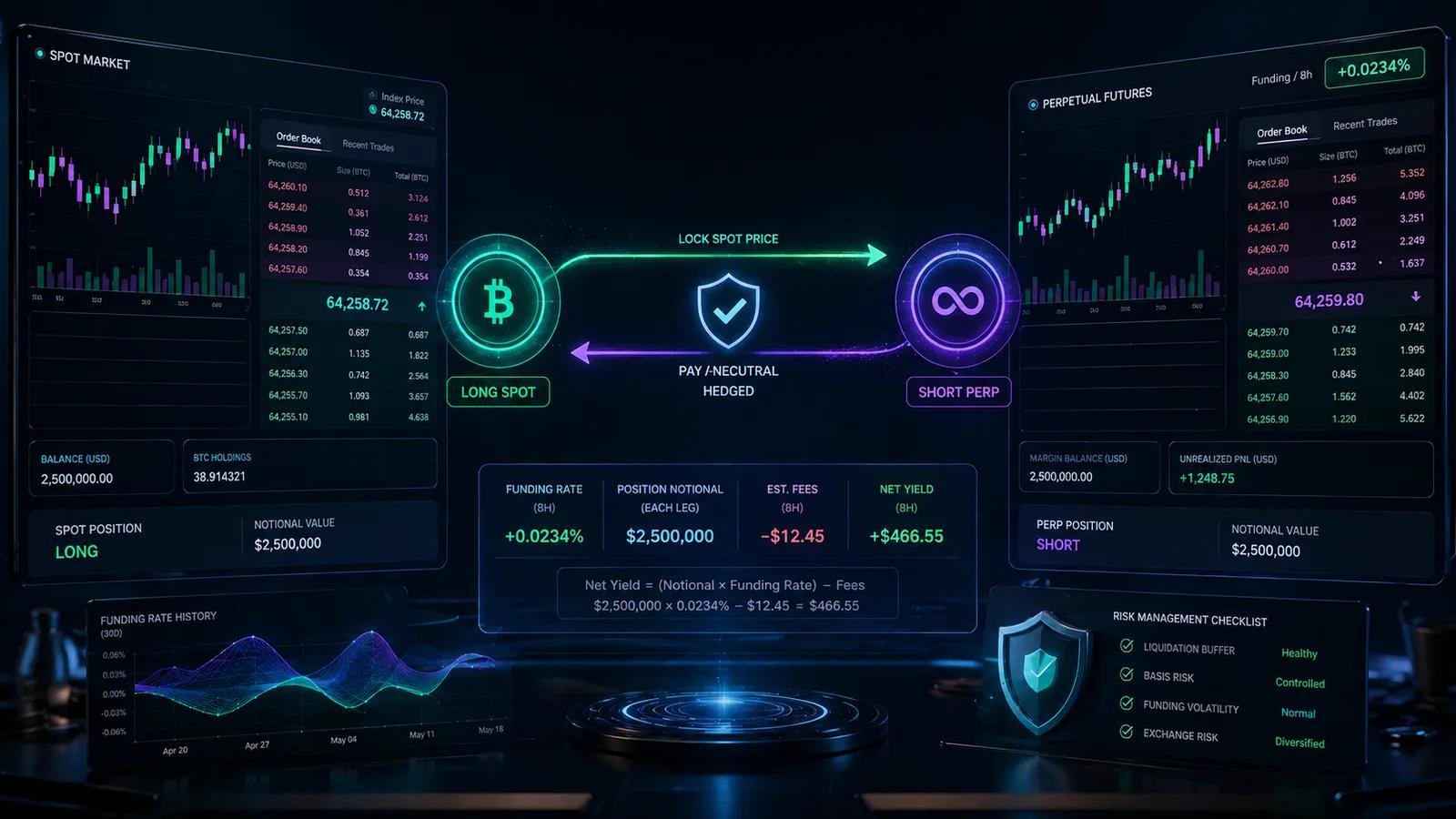
A common setup in a bullish/neutral regime is simple:
- buy spot,
- short perp with matched notional.
That hedge reduces directional exposure, so your edge comes mostly from funding payments and execution quality.
The Math Is Easy. The Discipline Is Hard.
Base formula:
Funding Income = Perp Notional x Funding Rate
Quick example:
- Notional short: $10,000
- Funding: 0.01% per 8h
- Income: about $1 per interval, about $3/day before fees
Looks straightforward. But the real performance depends on the line traders often ignore:
Net PnL = Funding Income - Fees - Slippage - Funding Flips - Basis Drift
That is why two traders can run "the same strategy" and get very different outcomes.
Capital and Position Sizing (Practical View)
Small accounts can still learn this strategy, but costs matter more at low notional sizes.
- Very small size: fees eat too much of gross funding.
- Mid-size accounts: fee tier + execution quality matter most.
- Larger size: liquidity, slippage, and operational reliability become more important.
The key is not just notional size. It is your ability to keep a healthy margin buffer and survive volatility without panic exits.
A Real-World Execution Checklist
Before entering:
- Funding has been favorable for multiple intervals (not a one-candle spike).
- Both legs have enough depth at your trade size.
- You know your estimated all-in cost.
- You can execute both legs quickly.
- Your liquidation buffer is conservative.
- You know the exact condition that will make you exit.
This checklist sounds basic, but skipping one item is where most avoidable losses begin.
The Risk Modes That Hurt Traders Most
Funding flips
The setup starts positive, then funding turns negative and carry becomes a cost.
Liquidation pressure
Hedged does not mean liquidation-proof. Fast moves can still threaten a thinly margined short leg.
Basis divergence
Spot and perp can decouple in stress windows, creating temporary but meaningful PnL distortions.
Exchange and operational risk
API outages, withdrawal delays, or sudden fee changes can break assumptions mid-trade.
Slippage on size
Poor fills can erase days of expected funding income in one entry or exit.
Risk Controls That Actually Make a Difference
- Keep extra margin, not minimum margin.
- Re-check net edge daily.
- Prefer limit-first execution when practical.
- Split exposure across venues to reduce single-platform risk.
- Log every trade and compare expected vs realized results.
Over time, that process improves your strategy far more than hunting one "perfect" funding spike.
Using ArbiSight in This Workflow
A practical workflow with ArbiSight tools:
- Live Crypto Arbitrage for opportunity discovery
- Arbitrage Profits for quick return modeling
- Funding Cycle Timing Strategy for execution timing
- Orderbook Snapshot for fill-quality decisions
- Portfolio Management for active monitoring
Closing Thought
Funding arbitrage is one of the few crypto strategies where consistency beats excitement.
If you can stay process-driven, cost-aware, and strict on risk, this strategy can remain effective even when market conditions change.
Disclaimer: This article is educational content only and not financial advice. Trading carries risk, including loss of capital.