How to Trade Funding Arbitrage During High Volatility Without Panic
Crypto arbitrage during volatility sounds like an oxymoron. Arbitrage is supposed to be calm. Volatility is supposed to be loud.
In reality, some of the largest funding prints show up when markets are stressed — and that is exactly when execution, basis, and margin punish impulsive trades.
This guide is not about being fearless. It is about being boring on purpose: smaller size, wider buffers, clearer rules, and a monitoring stack that keeps you from reacting to every wick.
What Changes When Volatility Ramps Up
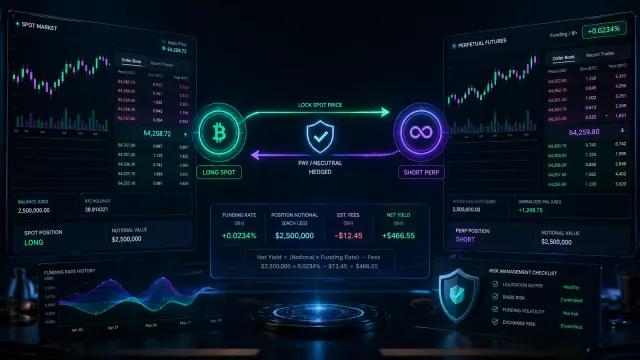
Volatility does not remove funding rate arbitrage opportunity. It changes the distribution of outcomes — which is why funding rate tracking and spread tracking should move in lockstep when conditions get loud:
- Funding can spike or flip quickly as positioning resets.
- Spot versus perp relationships can stretch and snap (basis risk).
- Liquidity can vanish in the book right when you need it.
- API latency matters more when prices move faster than your second leg.
So the question is not "is arbitrage perpetuals carry dead in high vol?" The question is whether your process is robust enough that you can still execute like a professional when screens turn red.
Rule 1: Volatility Is a Signal to Shrink, Not to Hero-Size
If your normal hedge size feels "fine" on a quiet Tuesday, it is often too large on a liquidation-heavy Thursday.
A practical default:
- cut notional until your worst-case basis move still leaves a boring margin cushion,
- prefer fewer venues when operational risk spikes,
- accept that some intervals are for observation, not deployment.
This is one of the highest-leverage habits in cryptocurrency arbitrage: capital preservation first, optimization second.
Rule 2: Pre-Define the Conditions Where You Will Not Trade
Panic is what happens when decisions happen after pain arrives.
Write down (literally) a short list of "no-trade" triggers, for example:
- funding flips sign twice within N intervals,
- spreads widen beyond a threshold you modeled,
- one exchange shows degraded status or abnormal withdrawal friction,
- you cannot get both legs filled within your time budget.
If you are newer to hedged workflows, this discipline overlaps with crypto arbitrage for beginners advice people ignore until they learn it the expensive way.
Rule 3: Execution Becomes the Product
In calm markets, a mediocre entry might still work.
In volatile markets, a mediocre entry can convert a hedged idea into a temporary directional bet — exactly what you were trying to avoid.
Execution habits that help:
- prefer limit-first logic when the book allows it,
- avoid "chasing" if the second leg refuses to come to you,
- re-quote rather than panic-crossing wider and wider,
- log fills and compare expected vs realized immediately.
For depth reality checks at your size, Orderbook Snapshot is useful because crypto arbitrage during volatility is often a liquidity story disguised as a funding story.
Rule 4: Monitoring Should Be Continuous, but Your Actions Should Be Rare
High vol rewards traders who can see early and intervene rarely — only when rules trigger.
A practical monitoring stack:
- Live Crypto Arbitrage for discovery and regime context.
- Arbitrage Profits to keep fee and assumption math honest.
- Funding Cycle Timing Strategy when cadence matters across venues.
- Portfolio Management for margin drift, leg imbalance, and "is this still the same trade?"
If you want lighter-touch awareness, free funding rate alerts and broader free arbitrage monitoring can reduce tab overload — as long as alerts feed a checklist, not adrenaline.
Rule 5: Treat "Scanner Safety" as Workflow Safety
People sometimes ask variations of is it safe to use arbitrage scanner tools in wild markets. The honest answer: an arbitrage scanner surfaces information; they do not remove liquidation risk, operational risk, or your own impatience.
A free crypto arbitrage scanner tier can still be valuable if you use it as triage — then confirm with depth, fees, and persistence before committing size.
Strong crypto arbitrage tools stacks usually pair a fast arbitrage screener layer with slower, deliberate confirmation steps — especially when futures arbitrage style hedges can gap between legs.
Spread tracking habits matter here too: when volatility rises, the "edge" you think you see is often a moving target.
The Mental Model: You Are Running a Process, Not Winning a Debate
Markets in high vol feel like they demand an immediate opinion.
Your job in funding rate arbitrage is closer to operations:
- keep the hedge balanced,
- keep margin boring,
- keep actions rule-based.
That mindset also clarifies how how does arbitrage bot work style automation differs from what many manual traders do: bots enforce rules — humans often break them under stress. You can borrow the good part (rules + alerts) without handing off judgment you are not ready to automate.
Closing Thought
Crypto arbitrage during volatility is not about pretending risk disappears. It is about building a system where volatility is expected, so your responses are rehearsed instead of improvised.
When in doubt, shrink, slow down, and wait for a cleaner book. The best trade is often the one you skip calmly.
Disclaimer: This article is educational content only and not financial advice. Trading carries risk, including loss of capital.