When a Coin Surges 100%+ in 24 Hours: Funding Opportunities, Cycle Gaps, and Liquidation Risk
When a token goes vertical — more than a doubling inside a single day — markets do not just "get excited." They reorganize around leverage, urgency, and forced flows.
In that environment, funding rate and fee surfaces often look extreme. You will also frequently see funding cycle differences across exchanges (interval timing, caps, settlement quirks) that matter for funding rate arbitrage and futures arbitrage workflows.
This article explains why those opportunities show up, how cycle gaps can help earn from funding rate carry when execution is clean, and why liquidation risk spikes hard in both directions after a parabolic move.
Why Funding and "Fee Opportunity" Heat Up After a Mega Pump
Perpetual funding is a balancing mechanism. When price rips and levered longs pile into perps faster than the market can smooth positioning, positive funding can print aggressively and persist across multiple intervals — not always, but often enough that scanners light up.
Fee opportunity language can mean two different things:
- Carry opportunity (getting paid funding on a hedged short-perp structure when longs are paying shorts).
- Trading activity (wider spreads, more taker flow, more stress) — which can create short-lived dislocations, but can also raise realized costs if you are the one paying the chaos tax.
So "high opportunity" should never be read as "easy profit." It usually means high variance: bigger gross numbers, bigger ways to lose on execution.
Why Exchange Funding Cycle Differences Matter More Here
Not every venue settles funding on the same cadence or with the same mechanics. In calm markets, those differences are a rounding error. In a 100%+ / 24h episode, they can become a first-class trading variable:
- One exchange may accrue funding faster (more frequent intervals).
- Another may print a different effective rate due to caps, index components, or transient imbalance.
- Time-zone and maintenance windows can line up poorly with your hedge plan.
For CEX arbitrage desks, that is exactly where cross-exchange funding rate tracking can create extra edge: you are not only comparing levels, you are comparing schedules and persistence. An arbitrage scanner or arbitrage screener helps rank symbols, but spread tracking is what keeps you honest when the book is moving faster than the UI.
If you are timing entries and exits, pairing discovery with Funding Cycle Timing Strategy is often the difference between capturing carry and accidentally stepping into a settlement window you did not model.
How alerts help you catch funding changes and cycle gaps faster
During a parabolic move, funding prints and predicted fees can move while you are away from the desk. Free funding rate alerts and in-app notifications exist to shrink the gap between "market changed" and "you noticed" — so you can run a short checklist (net edge, depth, hedge balance, margin) instead of finding out late from a social feed.
What to alert on (practically):
- predicted funding crossing bands you care about (strong positive or negative),
- time-to-next-funding on each venue (so you are not surprised at settlement),
- sudden changes in cross-exchange funding spread for the same symbol idea.
Example: mismatched funding clocks (illustrative — always verify live per contract): suppose Binance is on a 4-hour funding cycle for a USDT perpetual while BITUNIX is on a 1-hour cycle for the same trade theme. BITUNIX will refresh its funding snapshot more often, which means you may see the next positive or negative regime on BITUNIX first — and you can decide whether to add, trim, rebalance, or stand down before Binance reaches its next 4-hour boundary.
That pattern is exactly why cycle-aware traders pair funding rate tracking with notifications: the faster venue is often where you update your thesis, while the slower venue still sets your next large accrual jump.
Important: funding intervals are not universal; they vary by exchange, contract, and sometimes automatic rule changes when rates are extreme. Before you trade, confirm each venue's current funding countdown in its UI or API — treat any numeric example in this article as a workflow illustration, not a promise for every pair.
Inside ArbiSight, configure what pings you (including Telegram-style delivery if you use it) so alerts support a rule set, not impulse entries. If your deployment includes the dedicated alerts surface, Alerts is where you tune those thresholds alongside Live Crypto Arbitrage and Funding Cycle Timing Strategy.
The Upside (When the Trade Is Actually Rational)
The constructive case is disciplined and boring:
- Persistent positive funding (not one freak print),
- a hedge that keeps net direction mostly flat (spot-futures arbitrage / spot versus perp thinking),
- enough liquidity to enter and exit without donating the edge,
- and a margin buffer that assumes the pump can continue and reverse violently.
In those conditions, arbitrage perpetuals carry can look exceptional on an annualized screen — and sometimes it is real after fees — but only for traders who treat crypto arbitrage during volatility as an execution sport.
The Downside: Liquidation Risk Rises in Both Directions
This is the part people under-model.
After a huge up-move, the market is not "stable at a new level." It is often high gamma: fast continuation, fast mean reversion, wicks in both directions, and liquidity that appears and vanishes.
Even a hedged book can face liquidation pressure because:
- the short perp leg can move against you violently if price continues higher,
- a sharp dump can spike basis and margin requirements in ways that feel like a directional shock,
- partial fills and lag can leave you temporarily exposed,
- funding can flip quickly once positioning resets.
So yes: when a coin surges 100%+ in 24 hours, there is a real increase in liquidation probability for anyone using leverage — including traders who thought they were neatly hedged but sized too tight.
A Practical Risk Stack (Non-Negotiables)
If you are going to operate in these windows, the edge is usually "process," not bravery:
- Shrink size until the trade survives a continuation candle you would hate to see.
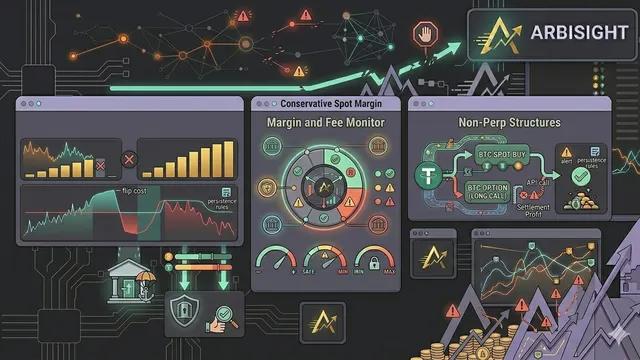
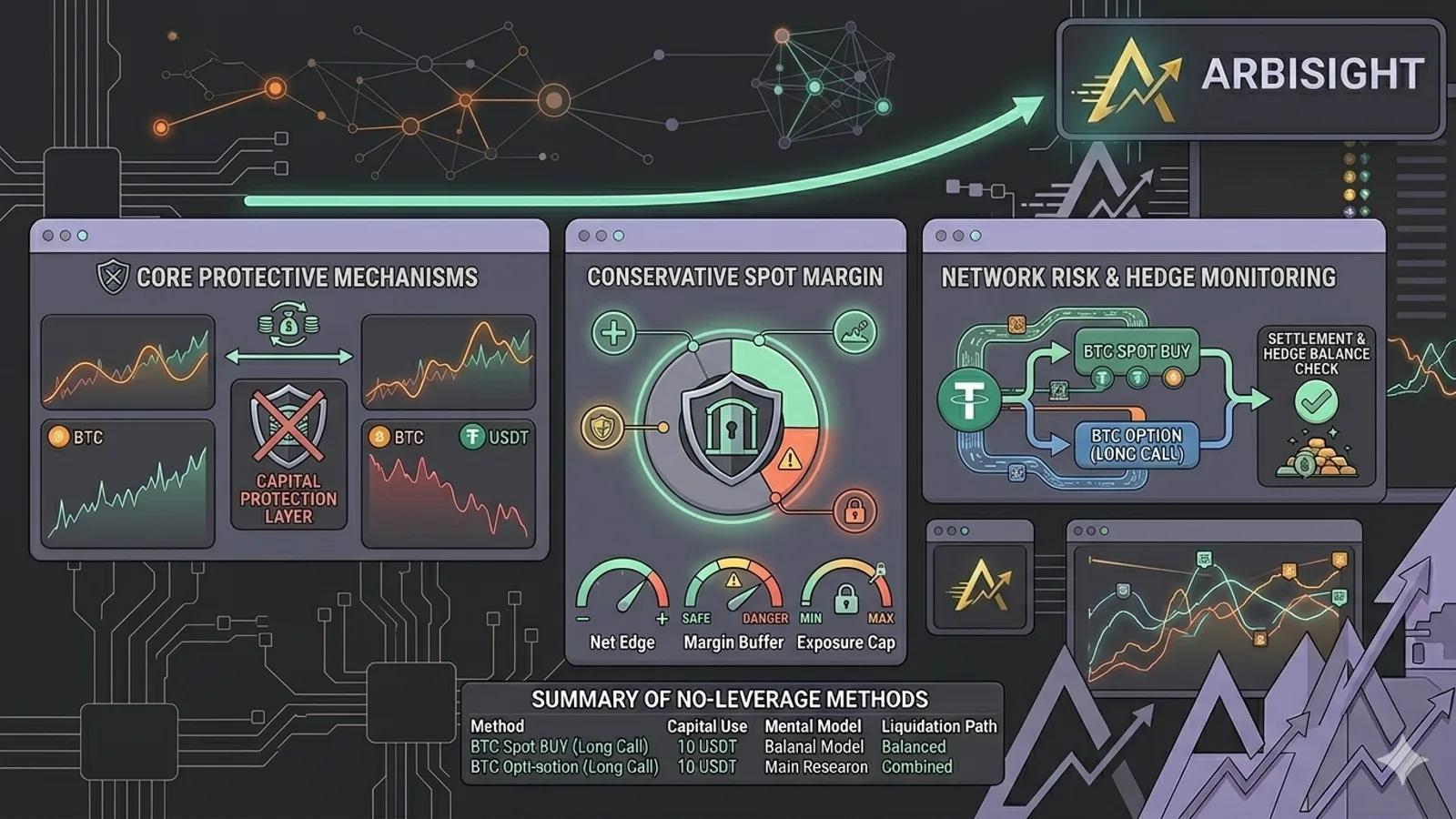
- Widen liquidation buffers — boring margin is the whole game.
- Pre-define no-trade triggers (exchange issues, funding flips, spread blowouts).
- Confirm depth with Orderbook Snapshot at your notional.
- Monitor drift and margin continuously with Portfolio Management.
For discovery and modeling context, Live Crypto Arbitrage and Arbitrage Profits help you separate headline funding from net outcomes — especially important when free crypto arbitrage scanner style feeds tempt you to chase the loudest symbol. Layer free funding rate alerts only if they reinforce a checklist; crypto arbitrage tools should reduce mistakes, not increase click speed.
When the Best Trade Is None
If you cannot hedge quickly, cannot access both legs reliably, or cannot explain your liquidation path in one sentence, the correct move is often to watch from the sidelines.
Cryptocurrency arbitrage in parabolic names is frequently won by traders who skip the worst sessions — not the ones who attend every party.
Disclaimer: This article is educational content only and not financial advice. Extreme short-term returns can reverse abruptly; you can lose capital, including on hedged strategies, due to leverage, basis, liquidity, and operational failures.