Price Arbitrage vs Funding Rate Arbitrage: What Actually Differs
Both strategies show up on the same crypto arbitrage scanner rows. Both often use two exchanges and a hedge. Both get called "arb" in group chats until something breaks.
They are not the same trade.
Price arbitrage is a bet on cross-exchange price levels converging (or on exiting the pair better than you entered). Funding rate arbitrage is a bet on scheduled funding cash flows between longs and shorts on arbitrage perpetuals—usually with a hedge that keeps directional exposure in check.
I run both. The damage comes from using the right tools for the wrong thesis.
What You Are Actually Arbitraging
| Price arbitrage | Funding rate arbitrage | |
|---|---|---|
| Core gap | Cryptocurrency price difference between venues | Funding rate difference or timing between venues |
| Typical question | "Why is BTC cheaper here and richer there?" | "Who pays funding next, and how much?" |
| Main P/L driver | Spread narrows (or exit improves) | Earn from funding rate over intervals |
| Horizon | Often hours (sometimes minutes) | Often days to weeks (intervals stack) |
If you cannot say which row you are trading in one sentence, pause before you size.
New to funding mechanics? Start with What Is Funding Rate in Crypto Perpetuals. New to price transport? Read when to take price arb and when to walk away.
Price Arb: Transport, Books, and Convergence
CEX arbitrage price trades care about ticker marks and orderbook reality. The headline crypto spread on Live Crypto Arbitrage is gross; your edge is net after bid–ask width on both venues—see gross vs net price gap.
What matters:
- sudden dislocations vs stale multi-day gaps (Price Chart history),
- whether you can fill entry and exit,
- why the cheap venue is cheap (withdrawals, index, delist risk—delisting article).
You are not harvesting a schedule. You are moving value between books before the gap changes or before liquidity punishes you on the way out.
Funding Arb: Carry, Cadence, and Persistence
Funding rate arbitrage cares about sign, size, and persistence of funding—and whether your hedge stays balanced through each print.
What matters:
- funding interval (1h vs 4h vs 8h) on each exchange,
- whether rates stay favorable across multiple cycles,
- basis between spot and perp if you use a spot–perp template,
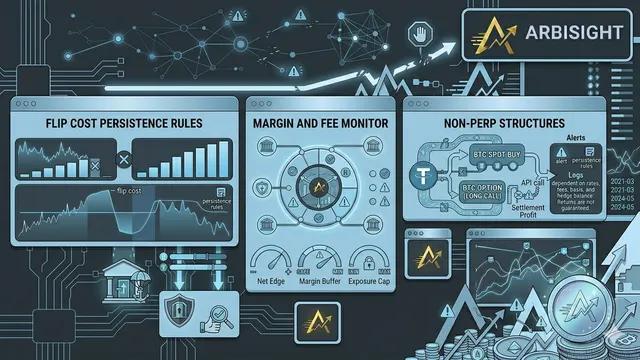
- margin and hedge drift in Portfolio Management.
You are not betting the two exchanges' prices match tomorrow afternoon. You are betting the funding ledger pays you more than fees, basis pain, and ops friction over time.
Model intervals with Arbitrage Profits and Funding Cycle Timing Strategy before you treat a fat print as income.
Same Hedge Shape, Different Risk Footprint
Both can look delta-neutral on paper: long here, short there. The risks diverge after that.
Price arb risks:
- spread widens instead of narrows,
- one book goes close-only or illiquid,
- phantom PnL from wide spreads that vanishes on close,
- policy/delist asymmetry between venues.
Funding arb risks:
- funding flips sign,
- basis blows out between spot and perp,
- mismatched funding cadence between exchanges,
- slow bleed when carry looked good for one interval only.
Same word—"hedged"—different failure modes.
When I Reach for Which
Price arbitrage when:
- I see a fresh surge in cross-exchange spread,
- net edge clears both orderbooks at my size,
- I have a convergence or exit story for the next few hours.
Funding rate arbitrage when:
- funding differential is persistent across cycles,
- cycles are understood (same or different—both are workable with process),
- hedge and margin can survive boring days, not just one lucky print.
Neither when:
- the only edge is a multi-day price plateau with no catalyst,
- funding is extreme but books/policy make hedging fiction,
- I am tired and clicking because the scanner row is green.
They Overlap in the UI—Do Not Overlap in Your Head
A wide price gap can coincide with wild funding. That does not mean one trade captures both.
- A Price Opportunity Telegram alert is about price diff % (setup guide).
- A Market Opportunity alert is about funding timing (alerts comparison).
Use the right alert, then the right checklist: price workflow vs funding alerts setup.
How ArbiSight Fits Both (Without Blending Them)
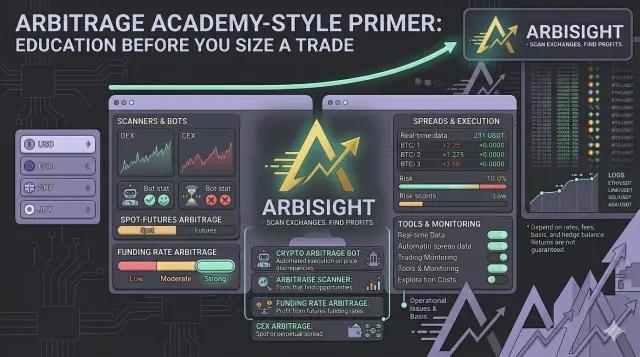
ArbiSight is crypto arbitrage tools for discovery and discipline—not a strategy picker.
- Price lane: Live Crypto Arbitrage, Price Chart, Orderbook Snapshot, Spread Analysis.
- Funding lane: Arbitrage Profits, funding views, Alerts, Watchlist.
- Both: Portfolio Management, Slow Entry when books are ugly.
A free arbitrage screener or best arbitrage scanner headline is a starting point. Your thesis decides whether you are transporting price or collecting carry.
Parting Thought
Futures arbitrage is an umbrella, not a strategy. Under it, price arbitrage is about spread tracking and executable gaps. Funding rate arbitrage is about interval cash flows on arbitrage perpetuals.
Mix them in conversation if you want. Do not mix them in one trade plan unless you have modeled both ledgers—and still expect Murphy's law to bill you twice.
Disclaimer: This article is educational content only and not financial advice. Trading carries risk, including loss of capital.