Crypto Arbitrage FAQ: Scanners, Bots, Funding, Spreads & Tools
If you are researching cryptocurrency arbitrage, you will see the same phrases everywhere: crypto arbitrage bot, arbitrage scanner, funding rate arbitrage, DEX scanner, CEX arbitrage, spot-futures arbitrage. This FAQ ties those terms together in plain language — what they mean, how they overlap, and what actually matters for execution and risk.
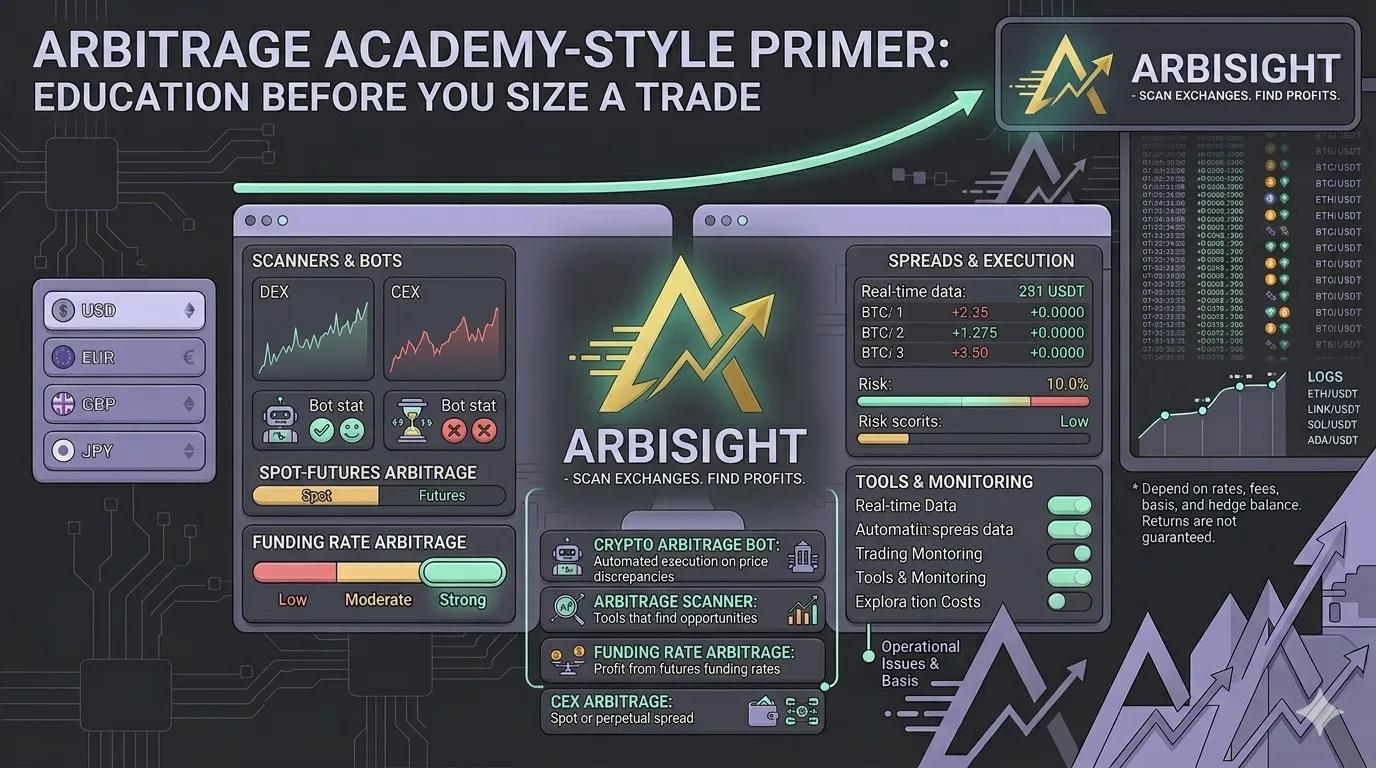
Think of it as a compact Arbitrage Academy-style primer: free arbitrage education you can use before you size a trade.
What is a crypto arbitrage bot or arbitrage scanner?
A crypto arbitrage bot is software that watches cryptocurrency price differences across venues and either alerts you or places orders according to rules you set.
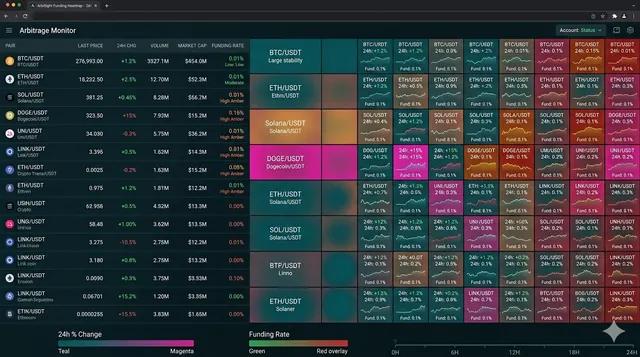
An arbitrage scanner (people also say arbitrage screener) is usually the discovery layer: it surfaces gaps and crypto spread in real time so you do not have to tab-switch across exchanges. Some products combine both — scan plus automation — and label the whole thing a bot.
How does an arbitrage bot work?
Most bots follow the same loop:
- Pull prices (and often order books or funding) from one or more exchanges.
- Compare symbols and contracts to find a net-positive edge after fees.
- Either notify you or submit orders on both legs.
The important detail: execution and fees decide whether the cryptocurrency price difference you see on screen becomes profit. The bot does not remove liquidity risk, API outages, or partial fills — it just speeds up detection and (sometimes) execution.
Is a DEX scanner the same as a CEX tool?
Not exactly. A DEX scanner or DEX tool focuses on decentralized venues: pools, routes, gas, and slippage. CEX arbitrage tools emphasize centralized order books, taker/maker fees, and API reliability.
Many traders use both because CEX to DEX arbitrage (and the reverse) appears when on-chain and off-chain prices drift — but bridges, settlement time, and smart-contract risk add complexity that pure CEX arbitrage does not have.
What is CEX to DEX arbitrage?
CEX to DEX arbitrage means buying (or selling) on one environment and hedging or exiting on the other to capture a mispricing. The edge must cover trading fees, withdrawal or bridge costs, latency, and sometimes blockchain analysis-level uncertainty (failed txs, MEV, nonce issues).
This is why serious traders pair DEX scanner signals with execution discipline — not just the headline spread.
What are arbitrage perpetuals?
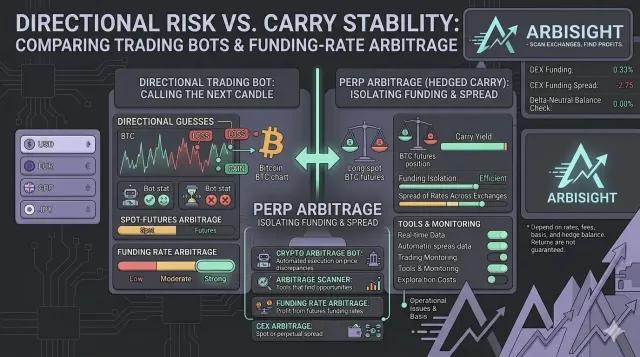
Arbitrage perpetuals usually refers to strategies built around perpetual futures — for example, hedged long/short across exchanges or against spot. Perps introduce funding, margin, and liquidation rules, so arbitrage perpetuals are really "perp-vs-perp" or "spot-vs-perp" systems under a funding and basis regime.
What is funding rate arbitrage?
Funding rate arbitrage (also called funding arbitrage) collects payments from the perpetual funding rate mechanism while staying close to delta-neutral — commonly spot plus an offsetting perp leg, or two perps with matched notionals.
Funding rate tracking matters because funding flips with sentiment and volatility; the gross rate is not the same as net profit after fees and slippage.
What is spot-futures arbitrage?
Spot-futures arbitrage exploits the relationship between spot and futures on the same asset. A classic template is long spot / short futures (or the reverse) when basis and funding make the carry worthwhile.
People sometimes search for a spot futures arbitrage bot — that is usually automation around the same hedge idea: synchronized legs, size matching, and risk caps.
What about futures arbitrage more broadly?
Futures arbitrage can mean calendar spreads, cross-exchange perp spreads, or spot-perp basis trades. A futures spread calculator (or spreads calculator) helps translate quoted prices and contract specs into the actual crypto spread you will pay or receive — essential when contracts use different tick sizes, multipliers, or settlement rules.
Why is spread tracking important?
Spread tracking turns noisy quotes into a decision: Is the edge stable? Is it widening because liquidity vanished? Without spread tracking, it is easy to chase a cryptocurrency price difference that disappears on the next tick.
Manual trading bot vs automated trading bot — what is the difference?
- Manual trading bot (an informal label): scan + alert workflows where you click final execution — good when you want human gates on size and venue choice.
- Automated trading bot: rules-based order placement — faster, but unforgiving if parameters ignore fees, depth, or downtime.
Many professionals blend both: automation for monitoring, manual for large or fragile routes.
What is the best crypto arbitrage scanner or service?
No honest vendor should promise "best" for everyone. When you compare the best arbitrage scanner or best cryptocurrency arbitrage service for your own trading, check:
- Coverage of the exchanges and chains you actually use
- Whether funding and fees are part of the signal (not just mid prices)
- Alert delivery (web, mobile, Telegram scanner / TG scanner)
- Portfolio and risk views for multi-leg positions
Crypto arbitrage between exchanges — what breaks the trade?
Crypto arbitrage between exchanges fails most often because of partial fills, withdrawal delays, different contract specs, or sudden fees — not because the arbitrage screener was "wrong." Treat transfers and API health as first-class risks.
Is it safe to use an arbitrage scanner?
Is it safe to use an arbitrage scanner? In general, read-only market data tools are lower risk than granting withdrawal permissions to a stranger bot.
Safety depends on what you connect: API keys with least privilege, IP allowlists where supported, and avoiding "too good to be true" guaranteed-return schemes. A scanner helps you see opportunity; it does not remove market or operational risk. For mindset and checks, see our piece on whether crypto arbitrage opportunities are safe.
What are realistic crypto arbitrage earnings?
Crypto arbitrage earnings vary with capital, fee tiers, latency, and how often you capture net-positive edges. Funding strategies might accrue slowly but steadily; cross-exchange cryptocurrency arbitrage might be rarer but larger per event — and earn from funding rate outcomes still depend on stable differentials and disciplined sizing.
Crypto arbitrage for beginners — where to start?
For crypto arbitrage for beginners, start with education and measurement:
- Learn one strategy class deeply (funding rate arbitrage or cross-exchange spot, not five at once).
- Paper-track or small-size until crypto arbitrage earnings match your model.
- Use crypto trading tools that show fees, depth, and funding together.
What is the most profitable type of cryptocurrency arbitrage?
The most profitable type of cryptocurrency arbitrage on paper is often the one with the widest gross gap — but net profitability depends on costs and your operational constraints. Many traders find consistent net results from careful funding rate arbitrage and spot-futures arbitrage with strong risk controls, rather than chasing one-off cross-venue fireworks.
Telegram bot and TG scanner — how do they fit in?
An arbitrage bot (Telegram bot) pushes alerts to your phone when spreads or funding crosses thresholds — a practical TG scanner workflow if you cannot watch charts all day. Connect only official bots from products you trust, and treat alerts as starting points for verification — not blind execution signals.
Do I need blockchain analysis for arbitrage?
For pure CEX arbitrage, often no. For DEX routes, bridges, or wallet-level settlement, blockchain analysis skills help you debug delays, fees, and failed transactions — useful alongside crypto arbitrage tools.
What about an AI assistant for crypto?
An AI assistant crypto feature might summarize data or explain terms, but it does not replace exchange rules, live liquidity, or your risk limits. Use AI as a tutor and organizer — not as a permissionless autopilot for leverage.
Affiliate program crypto and white label arbitrage business
Some platforms offer an affiliate program crypto marketers can join; white label arbitrage business models repackage data or tools for other brands. If you evaluate those programs, look for transparent disclosures, tracking, and whether the underlying crypto arbitrage tools are genuinely useful to end traders — not just funnels with noisy signals.
Where can I get free arbitrage education?
This FAQ is a starting point for free arbitrage education. For deeper strategy reading, our funding rate arbitrage guide goes step by step on carry, fees, and risk. For product workflow, how to use ArbiSight to find crypto arbitrage opportunities walks through scanners, alerts, and portfolio tracking.
How ArbiSight fits into this stack
ArbiSight is built as crypto arbitrage tools for discovery and monitoring — not a promise of profits. Useful entry points:
- Live Crypto Arbitrage for a live arbitrage scanner / arbitrage screener view
- Arbitrage Profits for combined funding and orderbook-style analysis
- Alerts for Telegram-style notifications when your thresholds hit
- Orderbook Snapshot before you trust a displayed crypto spread
- Funding Cycle Timing Strategy for cycle-aware entries
- Portfolio Management for spread tracking and position math across legs
- Slow Entry Strategy when you want scaled, manual-style execution with structure
Disclaimer: This article is for educational purposes only and is not financial advice. Trading and bridging crypto involve risk of loss. Always do your own research and use least-privilege API keys.