When Altcoin Season Hits: How Funding Rates Spike and How to Profit
"Altcoin season" is a narrative label traders slap on a messy reality: more risk appetite, more leverage, and more attention rotating through smaller names.
That combination is exactly why altcoin season funding rate arbitrage becomes a recurring conversation — not because every alt prints free money, but because perpetual funding is sensitive to crowded positioning in markets that are often thinner and more reflexive than majors.
Funding rate tracking on alts is less about chasing every headline and more about spotting persistence and cross-exchange disagreement while liquidity still supports two-sided execution — the same lens many CEX arbitrage desks apply to futures arbitrage books.
This article explains how funding can spike, what "profit" should mean in a hedged framework, and where the strategy tends to break.
What Usually Changes During Altcoin Season
There is no official switch. Practically, alt seasons show up as some mix of:
- Breadth: more tokens participating in sustained rallies (even if leadership rotates weekly).
- Leverage appetite: perpetual open interest grows faster on speculative names.
- Narrative velocity: social attention moves faster than risk controls.
When those ingredients stack, funding can print elevated positive rates more often — especially when long leverage clusters in perps.
That environment can support funding rate arbitrage if you are harvesting carry with a hedge, not betting you can outrun liquidation math on a vertical chart.
Why Funding Spikes Hit Alts Harder Than Majors
Two mechanical reasons show up again and again:
1) Liquidity is thinner
The same positioning imbalance can move funding more aggressively when the book cannot absorb flow smoothly.
2) Crowding is faster
Alts can attract levered longs quickly during hype windows. Funding is the pressure valve — it can jump fast, and it can mean-revert fast.
That is why persistence matters. A one-interval monster print is often noise. What arbitrage traders usually want is repeated skew across multiple funding events — or cross-exchange dispersion that does not vanish on the next refresh.
How to Think About "Profit" (Carry, Not Lottery Tickets)
In a hedged framing, profit is closer to:
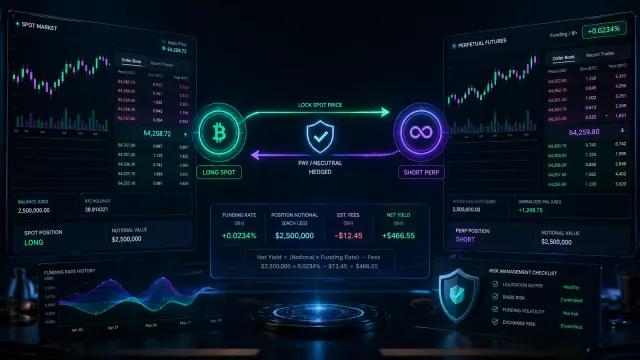
Net carry ≈ funding income − fees − slippage − basis drift − operational surprises
A common delta-neutral shape when funding is positive (longs pay shorts) is:
- long spot (or spot-like exposure),
- short perp with matched notional.
You are trying to earn from funding rate payments while keeping directional exposure mostly flat — a spot-futures arbitrage / arbitrage perpetuals workflow, not a call option on vibes.
If you are searching for the most profitable type of cryptocurrency arbitrage, the boring truth is that execution and fees usually decide outcomes — especially on alts where taker costs and partial fills hurt more.
The Altcoin-Specific Risks People Underestimate
Cryptocurrency arbitrage on smaller names adds operational complexity:
- Listing/delist/maintenance events can change availability overnight.
- Basis can whip harder when spot and perp disagree during fast rotations.
- Correlation spikes can stress margin even when you feel hedged.
- Attention decay can flip funding quickly once the narrative moves.
If you are newer to hedged workflows, treat these as core crypto arbitrage for beginners lessons — not footnotes.
A Practical Workflow (Discovery → Confirmation → Monitoring)
Altcoin season funding rate arbitrage rewards a funnel, not a reflex:
- Use Live Crypto Arbitrage to surface what is moving now — a free crypto arbitrage scanner mindset works here as triage, not autopilot. Pair it with spread tracking discipline so crypto arbitrage tools do not become a leaderboard addiction.
- Use Arbitrage Profits to translate headline funding into something closer to net outcomes after your fee and slippage assumptions.
- Use Orderbook Snapshot to confirm your notional is real for both legs.
- Use Funding Cycle Timing Strategy when cadence differs across venues.
- Use Portfolio Management to catch drift, margin pressure, and leg imbalance early.
If you want lighter-touch awareness, free funding rate alerts and broader free arbitrage monitoring can help — as long as alerts feed a checklist, not FOMO sizing.
Scanner Hygiene: Ranking Names Without Chasing Every Spike
A strong arbitrage screener / arbitrage scanner habit is to rank symbols by stability, not by peak:
- Does the symbol stay near the top across refreshes?
- Does dispersion between exchanges persist?
- Does liquidity support your size without paying away the carry?
That is also the practical layer behind questions like is it safe to use arbitrage scanner tools: scanners reveal candidates; risk is still your sizing, margin buffer, and exit rules.
Closing Thought
Altcoin season can absolutely produce funding rate arbitrage windows — usually because leverage and attention concentrate in perps on names that move funding aggressively.
The traders who "profit" without panic are the ones who treat spikes as data, size for thin books, and refuse to confuse a great screenshot with a great net trade.
Disclaimer: This article is educational content only and not financial advice. Altcoins can be extremely volatile and illiquid; you can lose capital, including on hedged strategies if risk controls fail.