Best Market Conditions for Funding Rate Arbitrage (And How to Spot Them)
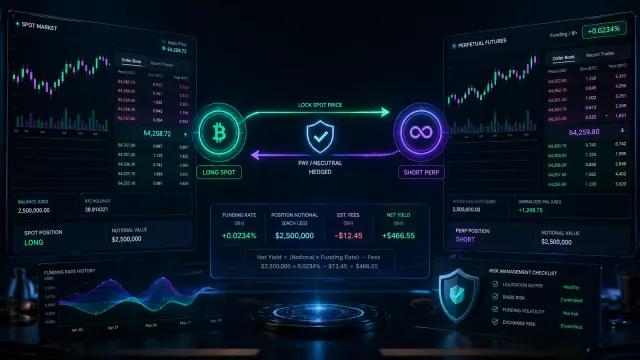
Funding rate arbitrage is less about guessing the next candle and more about recognizing when the market is structurally willing to pay you to hold a hedge.
The best conditions for funding arbitrage rarely announce themselves with a headline. They show up as persistent skew, cross-exchange disagreement, and execution you can actually achieve after fees.
This guide walks through the regimes that tend to help, the red flags that look like opportunity, and a repeatable way to spot durable setups with a crypto arbitrage scanner workflow.
What "Best Conditions" Really Means
Traders sometimes treat "high funding" as synonymous with a good trade. In practice, the best conditions for funding arbitrage usually combine:
- Funding that stays on your side across multiple intervals (not a one-print spike).
- A fee- and slippage-adjusted edge that still clears your hurdle after realistic execution.
- Liquidity and margin headroom so you are not one volatility burst away from a forced exit.
- A basis environment you can manage (spot versus perp drift will still move your mark-to-market even when you are hedged).
If one of those is missing, you might still earn from funding rate payments sometimes — but you are not in the "best conditions" bucket. You are in the "hope and tight stops" bucket.
Regime 1: One-Sided Crowding (Slow-Burn Carry)
Perpetual funding exists to nudge price toward index. When positioning gets crowded on one side, funding often reflects that imbalance for longer than people expect — especially when spot flow does not immediately validate the same bias.
What tends to help delta-neutral carry:
- Funding prints the same sign repeatedly, with magnitude that is elevated but not absurd.
- Open interest builds while price action is trending or chopping, not violently gapping.
- You can explain the skew in plain language (for example: "levered longs are paying shorts"), without needing a fragile narrative.
This is one of the cleaner paths to earn from funding rate income because the edge is tied to positioning mechanics, not a single headline.
Regime 2: The "Sweet Spot" Volatility Band
Extremely calm markets can still pay funding, but they also attract competition — spreads tighten and everyone leans into the same carry.
Extremely chaotic markets can print huge funding, but they also raise:
- liquidation risk on the perp leg,
- basis shocks between spot and perp,
- API and operational stress.
Many experienced traders find a practical middle ground: enough volatility to keep funding interesting, but not so much that execution and margin safety degrade. That band is not a fixed number; it is something you learn by pairing funding rate tracking with how your fills actually behave at your size.
Regime 3: Dispersion Across Venues (Same Asset, Different Pressure)
Some of the best conditions for funding arbitrage show up when two exchanges disagree on how stressed the same perpetual should be.
That disagreement can create:
- a more attractive entry on one venue,
- or a better hedge pairing when you combine arbitrage perpetuals workflows with careful operational controls.
This is where a disciplined arbitrage screener habit matters: you are not only looking for "big funding," you are looking for stable rank — the same names sitting near the top of your list across refreshes.
How to Spot Good Conditions Before They Fade
Think like a researcher, not a gambler. Here is a lightweight checklist you can run daily:
1) Persistence over amplitude
Ask: has funding favored the same direction through multiple funding events? A single extreme print is often mean-reverting noise.
2) Net edge after costs
Model taker fees, realistic slippage, and any borrow or transfer assumptions. If the edge barely clears zero, crowded carry can disappear the moment fees move.
3) Liquidity reality check
Use depth and recent trade prints to sanity-check whether your notional is small enough to enter and exit without paying away the carry. Tools like Orderbook Snapshot help you judge whether the opportunity is real at your size.
4) Basis and liquidation buffer
Even hedged books can get painful if basis runs against you while funding flips. Keep margin buffers boringly conservative and know your unwind plan.
5) Operational redundancy
If your strategy requires two venues behaving perfectly at the same second, stress-test what happens when one leg lags.
Red Flags That Mimic "Best Conditions"
Some setups look like the most profitable type of cryptocurrency arbitrage on paper, and then fail in execution.
Watch for:
- Funding spikes during illiquid hours that revert next interval.
- Thin books that turn a "high APR" into a one-fill mirage.
- Exchange-specific stress (withdrawal friction, maintenance, sudden margin parameter changes).
- Narrative chasing where social media hype runs ahead of positioning data.
If you are newer to this style of trading, treat these red flags as part of crypto arbitrage for beginners education — they are expensive lessons when ignored.
Using a Scanner Without Overfitting to Noise
Cryptocurrency arbitrage rewards process: the goal is not to react to every flicker, but to rank what matters. A free crypto arbitrage scanner tier can still be useful if you treat it as a triage layer — then you confirm edge with depth, fees, and persistence before committing capital.
A strong workflow pairs discovery with discipline:
- Start with Live Crypto Arbitrage to surface live dislocations and context.
- Use Arbitrage Profits to translate gross funding into something closer to expected return after your assumptions.
- Add Funding Cycle Timing Strategy when your edge depends on interval timing and cadence.
- Monitor positions with Portfolio Management so drift, margin, and leg risk do not sneak up on you.
Combine those pages with good spread tracking habits: the best arbitrage scanner workflows treat crypto arbitrage tools as a stack (discovery, sizing, execution, monitoring), not a single number on a leaderboard.
If you want always-on awareness without staring at screens, free funding rate alerts and broader free arbitrage monitoring can be a sensible complement — as long as you still confirm liquidity and net edge before sizing up.
Many traders also keep a manual trading bot mindset: automate notifications, keep execution human and rule-based. That split often ages better than fully automated entries built on fragile assumptions.
Closing Thought
The best conditions for funding arbitrage are less about a magical market mode and more about stacking small advantages: persistent skew, cross-exchange dispersion when it appears, conservative margin, and honest fee math.
When those line up, funding rate arbitrage can feel almost boring — which is usually a good sign.
Disclaimer: This article is educational content only and not financial advice. Trading carries risk, including loss of capital.