Why Bull Markets Create the Best Funding Arbitrage Opportunities
If you have ever watched perpetual funding during a strong uptrend, you have seen the same pattern repeat: levered longs pile in, open interest grows, and funding skews positive — sometimes for long stretches.
That environment is exactly why many traders associate bull market funding rate arbitrage with some of the cleanest carry windows in crypto: the market is often willing to pay shorts (and hedged structures that include a short perp leg) simply to keep the perpetual anchored while optimism stays crowded.
This article explains the mechanism in plain terms, where it breaks, and how to separate durable funding rate arbitrage from fragile hype spikes.
The Mechanical Link Between Bulls and Positive Funding
Perpetuals use funding to pull price toward the index. When positioning is heavily long-biased, the funding rate frequently reflects that imbalance:
- Positive funding (in the common convention): longs pay shorts.
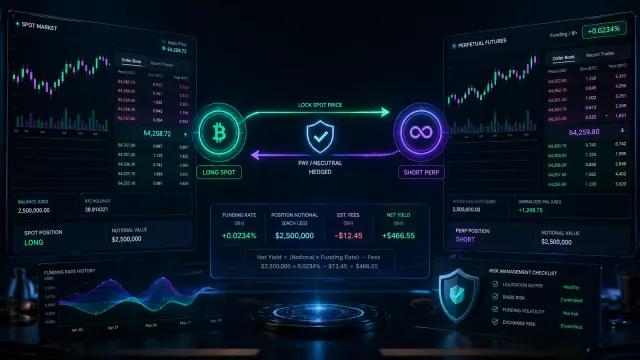
A classic delta-neutral playbook in that regime is:
- Buy spot (or a spot-like long),
- Short the perp with matched notional.
That structure is the practical side of spot-futures arbitrage thinking: two related legs, one economic exposure you are trying to neutralize.
You are not trying to predict the next leg higher. You are trying to harvest who pays funding while keeping net direction mostly flat — a futures arbitrage / arbitrage perpetuals mindset, not a moonshot bet.
In many bull phases, the same narrative that attracts buyers also attracts leverage. That leverage is what keeps the funding tape interesting for hedged carry.
Why Bull Markets Can Sustain Funding Pressure Better Than Panic Windows
Bear-market squeezes can print extreme funding too — but those episodes are often violent, short, and operationally expensive:
- books gap,
- basis can whip,
- liquidation cascades reorder the tape in minutes.
Bull regimes — especially grind higher trends — sometimes produce a steadier backdrop for funding rate tracking because the positioning imbalance can persist without constant deleveraging shocks.
That persistence matters because earn from funding rate strategies compound through intervals, not through one lucky print.
Not Every Bull Leg Pays the Same Way
Calling something a "bull market" is not enough detail. Two bull shapes behave very differently for carry:
Slow trend / accumulation
Funding can stay elevated enough to be meaningful, while volatility is not constantly threatening margin.
Late euphoria / vertical moves
Funding can spike to levels that look incredible on an annualized screen — and simultaneously raise:
- liquidation risk on the short perp leg,
- basis shocks if spot and perp temporarily disagree,
- execution risk when everyone rushes the same CEX arbitrage idea.
The best bull market funding rate arbitrage windows are often boring on a chart and persistent on a funding leaderboard — not the single craziest APY screenshot on social media.
The Trade-Off: More Opportunity, More Competition
Bulls do not hide the edge. They advertise it.
That means:
- more traders run hedged carry,
- fees and liquidity become the sorting hat,
- small mistakes in execution matter more.
This is why serious traders pair discovery with crypto arbitrage tools that help them see net outcomes, not just gross funding.
How to Spot Bull-Market Funding Edges Without Chasing Noise
Cryptocurrency arbitrage in bull phases rewards patience: the arbitrage scanner layer tells you what is loud today; your process tells you what is still true after fees tomorrow.
Treat bull market funding rate arbitrage like a funnel:
- Rank persistence — does the same symbol stay favorable across multiple funding events?
- Check dispersion — is one exchange paying materially more than another for the same story?
- Model all-in costs — taker fees, slippage, borrow or transfer assumptions.
- Confirm depth — can you enter and exit at your size without donating the carry back?
- Stress margins — bulls still have -20% weeks; your short leg needs room.
For discovery and sizing context, a practical stack is:
- Live Crypto Arbitrage for real-time opportunity scanning (free crypto arbitrage tools can still be useful here if you treat them as triage, not autopilot).
- Arbitrage Profits to translate headline rates into something closer to expected return after your assumptions.
- Funding Cycle Timing Strategy when cadence across venues matters.
- Orderbook Snapshot when you need evidence that liquidity supports your notional.
- Portfolio Management to monitor drift, margin, and leg risk as conditions change.
If you want lighter-touch awareness, free funding rate alerts can help — as long as the final trade decision still goes through the checklist above.
Risks That Actually Get Worse in Bull Markets
Bulls flatter directional traders. They punish sloppy hedging.
Watch for:
- Correlation spikes where everything moves together and margins compress at the same time.
- Sudden de-risk events that flip funding fast (carry can invert).
- Basis surprises when perp premium collapses or widens faster than you rebalance.
- Operational load — more attention, more API traffic, more chances for partial fills.
None of this means funding rate arbitrage is "bad" in bulls. It means the best opportunities sit next to the biggest crowds — and crowds change behavior quickly.
Closing Thought
Bull markets create some of the best funding arbitrage opportunities because they reliably manufacture imbalanced positioning on the long side of perpetual markets — and funding is the pressure valve.
Your job is not to argue with the trend. It is to measure whether the carry is real after costs, whether it lasts, and whether your hedge can survive the same bull that makes the funding attractive in the first place.
Disclaimer: This article is educational content only and not financial advice. Trading carries risk, including loss of capital.